
A tyre that keeps losing air does not always have a puncture. Sometimes the problem is much smaller: the tyre valve or valve stem may be leaking.
A faulty valve can cause gradual pressure loss that is difficult to notice at first. You may inflate the tyre, drive normally for a few days, and then discover that the same tyre is low again.
If you are searching for tyre valve replacement in Dubai, the first step is to identify whether the valve is actually responsible for the air loss.
This guide explains the common bad tyre valve symptoms, what
causes valve leaks, when a valve stem needs replacement, how TPMS valves differ, and when professional inspection makes sense.
A tyre valve is the component that allows air to be added to the tyre and helps keep that air contained inside the tyre.
The valve is connected to the wheel and includes a mechanism that allows inflation while preventing air from escaping under normal conditions.
Depending on the wheel and vehicle, the valve may be:
Although the valve is small, it plays an important role in maintaining correct tyre pressure.
A damaged or deteriorated valve can therefore create a slow tyre valve leak even when the tyre itself has no obvious puncture.
Knowing the common bad tyre valve symptoms can help you identify a problem before it develops into a more serious tyre-pressure issue.
One of the clearest signs is repeated pressure loss from the same tyre.
For example:
This pattern can indicate a slow puncture, but a leaking valve is another possibility.
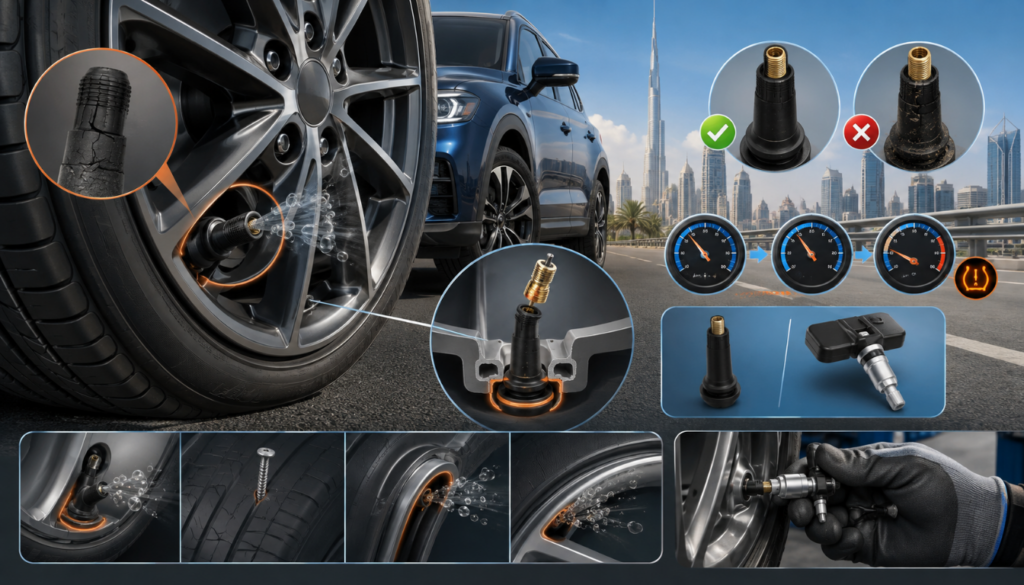
A damaged valve may leak air from the valve area.
A technician can test the valve to determine whether air is escaping.
Do not rely only on looking at the valve. Small leaks may not be visible without testing.
Rubber valve stems can deteriorate over time.
Look for:
A damaged valve should be assessed before the tyre is used for extended driving.
The valve cap is not the main component responsible for keeping tyre pressure inside the tyre, but it still provides useful protection against dirt and moisture entering the valve area.
A missing cap should be replaced.
However, replacing a missing cap does not fix an underlying valve leak.
If a tyre loses pressure shortly after being inflated, investigate rather than repeatedly topping it up.
Potential causes include:
A professional inspection can separate these possibilities.
A tyre losing air slowly can have several causes.
The valve is only one of them.
| Possible cause | Typical clue |
| Valve leak | Air loss around valve area |
| Small puncture | Gradual pressure loss |
| Bead leak | Air escaping around tyre/rim |
| Wheel damage | Persistent leak near rim |
| Tyre damage | Visible cut or structural issue |
| Temperature changes | Pressure changes without a physical leak |
This is why it is better to diagnose the source rather than immediately replacing the valve.
If the valve is healthy, replacing it will not solve a puncture elsewhere in the tyre.
Several factors can contribute to a tyre valve leak.
Rubber components can deteriorate over time, particularly when exposed to heat, sunlight and normal road conditions.
Dubai's climate makes regular tyre inspection particularly useful because vehicles experience high ambient and road temperatures.
The valve can be damaged during:
Metal valve components can develop corrosion depending on their construction and operating environment.
A valve that has not been fitted correctly may not seal properly.
The internal valve mechanism can also develop a fault and allow air to escape.
A suspected valve leak should be properly tested.
One simple diagnostic approach is to apply an appropriate leak-detection solution around the valve area and observe whether air bubbles develop.
A professional inspection can also check:
The key is to identify where the air is escaping.
A valve should not be replaced simply because a tyre is losing pressure.
These are two different situations.
A valve may need replacement when:
A tyre itself may need repair when a suitable puncture is found in the repairable area and the tyre remains structurally sound.
In other cases, tyre replacement may be necessary.
For example, a valve replacement will not fix a nail puncture in the tread.
This distinction can prevent unnecessary parts replacement.
The tyre valve stem is the part that extends through the wheel and provides access to the tyre's inflation valve.
When people search for tyre valve stem replacement, they are usually looking for replacement of the physical valve assembly rather than repair of the tyre tread.
The correct replacement depends on the wheel and vehicle.
A conventional rubber valve and a TPMS-integrated valve should not automatically be treated as interchangeable.
A valve stem may need replacement if it shows:
It can also make sense to inspect or replace compatible valve components during certain tyre-fitting jobs, depending on the condition and vehicle requirements.
The technician should confirm compatibility before installing a replacement.
Some modern vehicles use a tyre pressure monitoring sensor integrated with the valve assembly.
In these systems, the valve is not simply a conventional inflation stem.
The assembly may include a TPMS sensor that communicates tyre-pressure information to the vehicle.
This means that a TPMS valve replacement may involve more than replacing a standard rubber valve.
Depending on the vehicle, the replacement may require:
The exact process depends on the vehicle and TPMS design.
| Feature | Standard Valve | TPMS Valve Assembly |
| Inflation function | Yes | Yes |
| Pressure monitoring sensor | No | Usually integrated |
| Electronic communication | No | Yes |
| Programming may be required | No | Sometimes |
| Vehicle-specific compatibility | Usually simpler | More important |
| Replacement complexity | Lower | Can be higher |
If your vehicle has TPMS, don't assume that a standard valve can replace the original sensor-equipped assembly.
It can contribute to a TPMS warning if the valve leak causes the tyre to lose enough pressure to trigger the system.
There is also another possibility: the TPMS valve/sensor assembly itself may have a fault.
This creates an important distinction.
The tyre gradually loses pressure.
The tyre may have correct pressure while the vehicle still reports a monitoring-system problem.
The actual tyre pressure should therefore be checked before assuming the dashboard warning is caused by a sensor.
This is also why the new TPMS article and this valve article should remain separate:
TPMS warning → dashboard/system diagnosis
Valve replacement → physical air-loss/component problem
Heat can contribute to the ageing and deterioration of rubber components over time.
Dubai vehicles are exposed to high temperatures, intense sunlight and hot road surfaces, so tyres and their components need regular inspection. Dubai's Roads and Transport Authority (RTA) also recommends regular checks of tyre pressure and tyre condition, particularly during the summer months.
However, heat should not automatically be blamed for every valve problem.
A leaking valve may simply be:
Proper diagnosis is more useful than assuming the cause.
Valve condition should be checked whenever tyres are being replaced.
Whether a valve should actually be replaced depends on:
If the valve is visibly deteriorated or leaking, replacement is sensible.
For TPMS-equipped vehicles, the technician should confirm the correct sensor/valve specification before replacement.
There is no single reliable price for every vehicle.
The cost can depend on:
A standard valve replacement is generally a simpler job than replacing a TPMS sensor/valve assembly.
Rather than choosing a service purely on the lowest advertised price, ask what the quoted amount includes and whether the correct valve specification is being used.
Driving on a tyre that is steadily losing pressure is not something to ignore.
As pressure drops, tyre performance and handling can change.
If you suspect a valve leak:
If the tyre becomes significantly underinflated or damaged, don't continue driving simply to reach a tyre shop.
You cannot prevent every valve failure, but basic maintenance helps.
Don't wait until the tyre looks visibly low.
During routine tyre checks, look for cracking or damage.
They help protect the valve from dirt and moisture.
A tyre fitting appointment is a good opportunity to inspect the valve and TPMS assembly.
If the same tyre repeatedly loses air, identify the cause rather than continually adding air.
This is particularly important for TPMS-equipped vehicles.
It isn't always possible to identify the cause visually.
| Symptom | Possible cause |
| Pressure loss from valve area | Valve leak |
| Nail/screw in tread | Puncture |
| Cracked valve stem | Valve deterioration |
| Air loss around rim | Bead/wheel issue |
| Correct pressure but TPMS fault | Sensor/system issue |
| Repeated slow pressure loss | Valve, puncture or bead leak |
If you're unsure, professional leak testing is the better option.
Arrange an inspection if:
A technician can determine whether the problem is the valve, tyre, wheel, bead or TPMS assembly.
A small valve problem can become frustrating when you repeatedly need to add air to the same tyre. The important thing is to identify the source of the pressure loss before replacing parts unnecessarily.
For Dubai drivers, mathyo tyres can provide tyre-related inspection and replacement support when a valve, tyre or TPMS-equipped valve assembly needs attention. This is particularly useful when a tyre is losing air slowly but there is no obvious puncture.
If a tyre needs to be removed to inspect the valve properly, professional tyre service can also help determine whether the correct solution is valve replacement, puncture repair, wheel-related repair or complete tyre replacement.
For vehicles equipped with TPMS, make sure the technician knows the vehicle specification before replacing the valve so that the correct sensor/valve assembly is used and any required TPMS relearning can be completed.
The goal isn't simply to replace a valve. It is to stop the air loss and restore the tyre system to a safe, properly maintained condition.
The Mathyo article-writing rules specifically require the final brand section to be unique, contextual, useful and connected to the article's actual search intent rather than using a generic promotional CTA.