
If your steering wheel starts vibrating while driving on Sheikh Zayed Road or you notice your car shaking at highway speeds, the issue may not be your tyres or suspension. In many cases, the problem is simply unbalanced wheels.
Wheel balancing is one of the most affordable yet important tyre maintenance services available. It improves driving comfort, helps tyres wear evenly, protects suspension components, and makes your vehicle safer at higher speeds. Despite its low cost, many Dubai drivers postpone wheel balancing until the vibration becomes difficult to ignore.
In this guide, you'll learn the average wheel balancing cost in Dubai, what influences the price, the warning signs to watch for, and when you should have your wheels balanced.
For most vehicles, wheel balancing is an inexpensive maintenance service.
| Vehicle Type | Cost Per Wheel | Full Set (4 Wheels) |
| Sedan / Hatchback | AED 20–40 | AED 80–160 |
| SUV / 4x4 | AED 30–60 | AED 120–240 |
| Luxury Cars (19"+ Wheels) | AED 40–80 | AED 160–320 |
The final price depends on several factors, including wheel size, tyre type, balancing method, and whether the service is performed at a workshop or through a mobile tyre service.
Note: The prices above are average market estimates for Dubai in 2026 and are provided for informational purposes only. They are based on publicly available pricing and service packages from UAE automotive service providers, including AutoFix UAE, AutoPro UAE, and Barari Tyres. Actual wheel balancing costs may vary depending on your vehicle type, wheel size, tyre condition, balancing method, additional services required, and whether you choose a workshop or mobile tyre service.
Wheel balancing is the process of ensuring that the combined weight of the tyre and wheel is distributed evenly around the axle.
Even brand-new tyres and alloy wheels have tiny manufacturing variations. As the wheel spins, these small weight differences create centrifugal force that causes vibration, particularly at higher speeds.
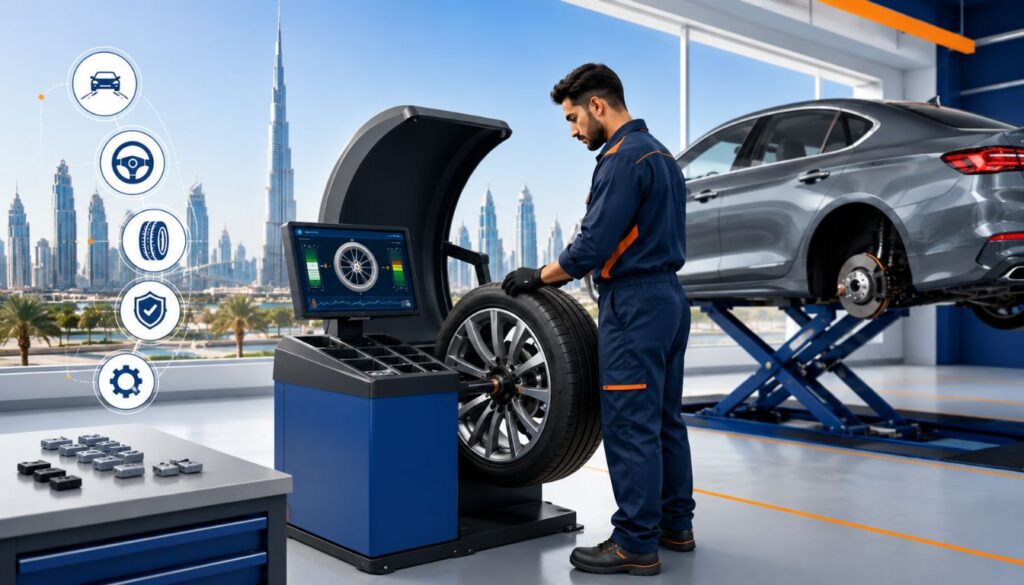
During wheel balancing, a technician mounts the wheel onto a computerized balancing machine. The machine identifies heavy and light spots, allowing small balancing weights to be attached to the wheel until it rotates evenly.
According to Michelin's Wheel Balancing Guide, proper wheel balancing helps reduce vibration, improves driving comfort, and promotes even tyre wear throughout the life of the tyre.
Properly balanced wheels provide:
Dubai's driving conditions place additional stress on tyres compared to many other cities.
Most daily commutes involve long stretches of highway driving, where speeds between 100–120 km/h are common. At these speeds, even a minor wheel imbalance becomes much more noticeable.
The UAE's high summer temperatures also contribute to faster tyre wear. Hot road surfaces increase tyre temperatures, making existing balance issues more noticeable and accelerating uneven tread wear if left untreated.
Dubai's hot climate and extended highway driving place additional stress on tyres. The Dubai Roads and Transport Authority (RTA) recommends maintaining tyres in good condition as part of safe vehicle operation and regular maintenance.
Drivers who frequently travel through areas such as:
are more likely to notice vibration caused by wheel imbalance because of sustained highway speeds.
Compared to suspension repairs or premature tyre replacement, wheel balancing is one of the most cost-effective maintenance services you can perform.
For most passenger vehicles, balancing all four wheels costs less than replacing a single premium tyre.
Average Cost: AED 80–160
Suitable for:
Average Cost: AED 120–240
Suitable for:
Larger tyres require additional balancing time and often heavier balancing weights.
Average Cost: AED 160–320
Suitable for:
Large alloy wheels require greater balancing precision, which typically increases labour costs.
Although wheel balancing is generally affordable, prices vary depending on your vehicle and the service you choose.
Larger wheels require more precise balancing and additional calibration.
For example:
Performance vehicles with oversized rims typically require more balancing weights and longer service times.
Some tyres are naturally more difficult to balance than others.
Examples include:
These tyres may require additional adjustments to achieve optimal balance.
Different wheel finishes require different balancing weights.
Common options include:
Adhesive weights are commonly used on premium alloy wheels because they preserve the appearance of the rim, although they may slightly increase the overall cost.
Many drivers now prefer mobile wheel balancing because it saves time and eliminates the need to visit a garage.
With mobile service, a technician comes directly to your:
While mobile balancing may carry a small convenience fee, many drivers find the time savings well worth it.
Wheel balancing is often discounted or included when performed alongside other tyre services, such as:
Booking multiple services together can provide better overall value than arranging them separately.
Absolutely.
Spending around AED 100–200 on regular wheel balancing can help prevent far more expensive repairs later.
Ignoring wheel imbalance may lead to:
Considering the cost of replacing premium tyres in Dubai, regular balancing is a small investment that helps extend tyre life and improve driving safety.
Wheel imbalance rarely develops overnight. In most cases, the symptoms become more noticeable over time, especially if you drive regularly on Dubai's highways. Recognising these early warning signs can help you avoid unnecessary tyre wear and more expensive repairs.
The most common symptom is vibration through the steering wheel, usually between 80 km/h and 120 km/h.
The vibration often starts subtly and becomes stronger as your speed increases. If you mostly feel it through the steering wheel, the front wheels are usually responsible. If the vibration is felt through the seats or floor, the rear wheels may need balancing.
An unbalanced wheel doesn't make even contact with the road surface. Over thousands of kilometres, this creates irregular tread wear.
Look for:
Replacing tyres early because of uneven wear is often far more expensive than routine balancing.
If your tyres have become noticeably noisier without any obvious damage, wheel imbalance may be contributing to the problem. As the tyre bounces slightly while rotating, it creates additional road noise, particularly on smooth highways.
A balanced vehicle should feel smooth and stable. If your car begins to feel unsettled at motorway speeds or you notice constant shaking during long journeys, your wheels should be inspected.
These two services are commonly confused, but they solve completely different problems.
| Wheel Balancing | Wheel Alignment |
| Corrects uneven weight distribution | Corrects wheel angles |
| Uses balancing weights | Adjusts camber, caster and toe |
| Eliminates steering vibration | Prevents vehicle pulling |
| Improves ride comfort | Improves steering accuracy |
| Prevents irregular tyre vibration wear | Prevents edge wear |
In some situations, both services are recommended together, particularly after replacing all four tyres.
Regular balancing keeps your tyres performing as intended and helps maximise their lifespan.
Most tyre professionals recommend balancing:
Because Dubai drivers spend considerable time on high-speed roads, routine balancing should be viewed as preventative maintenance rather than a repair.
Many drivers think wheel balancing only improves comfort, but its benefits extend much further.
Balanced tyres wear evenly, helping you get the maximum mileage from your investment.
Smooth-rolling tyres create less rolling resistance, which can contribute to slightly improved fuel economy over time.
Properly balanced wheels improve vehicle stability, particularly during motorway driving.
Persistent vibration places additional stress on:
Routine balancing helps reduce unnecessary wear on these parts.
One of the most noticeable improvements is smoother driving with reduced vibration and less driver fatigue on long journeys.
Although your vehicle may still be drivable, continuing to drive with unbalanced wheels is not recommended.
Ignoring the problem may result in:
The earlier the imbalance is corrected, the less likely it is to affect other vehicle components.
Yes.
Mobile wheel balancing has become increasingly popular in Dubai because it offers the same professional service without requiring a trip to a workshop.
A qualified technician arrives with professional balancing equipment and performs the service at your location.
This is particularly useful for:
Whether you're at home, your office or in apartment parking, mobile balancing offers a convenient alternative to waiting at a garage.
Regular wheel balancing is one of the simplest ways to extend tyre life, improve driving comfort and reduce unnecessary wear on your vehicle. Whether you've recently fitted new tyres, noticed vibration at highway speeds or simply want to keep your car performing at its best, professional balancing can make a noticeable difference.
At mathyo tyres, we provide professional mobile wheel balancing across Dubai, allowing you to have your wheels balanced at your home, office or other convenient location. Our experienced technicians use modern balancing equipment to deliver accurate results for sedans, SUVs, 4x4s and luxury vehicles.
If your vehicle also requires additional tyre services, our team can assist with:
Whether you're driving through Downtown Dubai, Business Bay, Dubai Marina, JVC, Al Barsha, Palm Jumeirah or Sheikh Zayed Road, mathyo tyres makes it easy to keep your tyres balanced, your vehicle running smoothly and your journeys safer on every road.