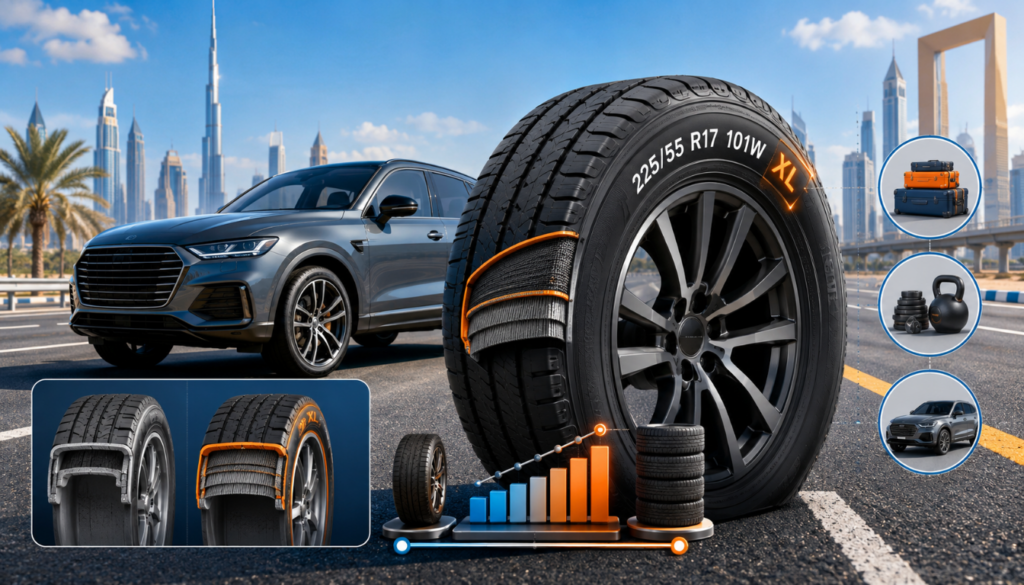

If you've seen XL printed on a tyre sidewall and wondered what it means, you're looking at an Extra Load tyre.
Extra Load tyres are designed to carry a higher load at specified inflation pressures than a standard-load version of the same tyre size and specification. They are commonly found on vehicles that need additional load capacity, including some SUVs, larger sedans, performance cars and heavily loaded vehicles.
But XL does not automatically mean a tyre is better for every car.
The correct tyre depends on your vehicle manufacturer's specifications, tyre size, load requirement, speed rating and intended use.
For UAE drivers, understanding the XL marking can help prevent the common mistake of choosing tyres based only on size or price.
XL means Extra Load.
An XL tyres is constructed to support a higher load capacity than a standard-load tyre of the same nominal size when used at the specified pressure.
You may see markings such as:
However, markings can vary between manufacturers, so drivers should always check the exact tyre specification rather than assuming that every abbreviation has the same meaning.
The important point is that XL relates to load-carrying capability, not simply tyre size.
For example, two tyres can have the same:
225/55 R17
size but different load specifications.
That means looking only at the size is not enough when selecting a replacement tyre.
Extra load tyres are tyres engineered to carry greater loads than the corresponding standard-load version under specified conditions.
Manufacturers can achieve this through differences in construction, materials and internal reinforcement.
Depending on the tyre design, Extra Load construction can provide the additional structural capability required for vehicles or applications where standard-load tyres may not meet the required load specification.
This can be relevant for:
But the correct choice should always start with the vehicle manufacturer's specification.
The simplest distinction is load capacity.
A standard-load tyre is designed around the normal load specification for that tyre size and application.
An XL tyre is designed to support a higher load under its specified operating conditions.
| Feature | Standard Load Tyre | XL / Extra Load Tyre |
| Load capacity | Standard specification | Higher specified capacity |
| Construction | Standard construction | Reinforced/heavier-load construction |
| Typical use | Standard vehicle applications | Vehicles requiring additional load capacity |
| SUV suitability | Depends on vehicle | Common on some SUVs |
| Performance use | Depends on specification | Common where higher load capability is required |
| Selection | Vehicle specification | Vehicle specification |
The important thing is that XL should not be treated as an automatic upgrade.
If your vehicle requires a standard-load tyre, fitting an XL version simply because it appears stronger isn't necessarily the correct choice.
Extra Load tyres use construction designed to withstand greater loads under their specified inflation conditions.
The exact construction varies between manufacturers and tyre models.
The additional capability can involve changes to areas such as:
The result is a tyre that can meet a higher load specification for its particular size and design.
This is why the complete tyre specification matters more than the letters XL alone.
A tyre's load rating indicates the maximum load that the tyre is designed to carry under the conditions specified by the manufacturer.
You may see a load index included in the tyre's sidewall markings.
For example, a tyre marking might look something like:
225/55 R17 101W XL
Here:
The exact meaning of the load index comes from the standardised load-index table.
So if you're checking the tyre load rating in the UAE, don't look only for "XL." The load index is another important part of the complete specification.
No.
This distinction is important.
XL describes the tyre's construction/load category.
The load index represents a specific maximum load value under the applicable conditions.
Therefore, an XL marking and a load index should be considered together.
For example, simply seeing "XL" does not tell you the exact kilograms that tyre can carry.
You need to check the actual load index and manufacturer specifications.
This is also why drivers should avoid choosing tyres based only on:
The complete specification must match the vehicle.
Not necessarily.
XL tyres are different, rather than universally better.
If your vehicle requires an Extra Load tyre, then choosing the correct XL specification is important.
But if your vehicle is designed for a standard-load tyre, there may be no reason to select an XL version unless the vehicle manufacturer or tyre specification allows it.
A tyre with a higher load capability isn't automatically:
Tyre performance depends on the complete design and how well the tyre matches the vehicle.
XL tyres can be suitable for SUVs when the vehicle manufacturer specifies or permits the appropriate Extra Load specification.
SUVs can have higher vehicle weights and different axle-load requirements compared with smaller passenger cars.
However, not every SUV needs XL tyres.
When choosing XL tyres for SUVs, check:
For example, an SUV used mainly for Dubai highways may have different tyre requirements from one regularly used for heavy loads or off-road driving.
They can, but the decision should come from the vehicle specification rather than Dubai's climate alone.
Dubai drivers deal with:
These conditions make correct tyre selection important.
However, XL does not mean "heat-resistant tyre."
An Extra Load designation tells you about the tyre's load capability. It should not be confused with a specific heat-resistance rating.
For UAE driving, you should consider the complete tyre specification:
Mathyo's broader tyre-selection content similarly advises UAE drivers to consider tyre size, speed rating, load capacity and driving conditions rather than selecting a tyre from one specification alone.
They can change the way a vehicle feels, but you should not assume that XL automatically means better handling.
The construction of an Extra Load tyre can influence characteristics such as:
But the actual driving behaviour depends on the specific tyre model, vehicle and inflation pressure.
If a vehicle manufacturer specifies an XL tyre, using the correct specification helps maintain the intended tyre characteristics.
Not necessarily.
Because XL tyres can have construction designed for greater load capacity, some vehicles may feel different when using them compared with a standard-load tyre.
Ride comfort depends on many factors:
Therefore, don't choose between XL and standard load based solely on comfort.
Follow the vehicle's approved specification first.
The price varies significantly by:
An XL version of a tyre may cost more than a standard-load version, but this is not a universal rule.
When comparing prices, compare the same size, load index, speed rating and tyre model wherever possible.
Otherwise, you may be comparing different specifications rather than different prices for the same tyre.
Understanding the sidewall makes tyre shopping much easier.
Consider this example:
245: Tyre width in millimetres.
45: Aspect ratio the sidewall height expressed as a percentage of tyre width.
R: Radial construction.
19: Wheel diameter in inches.
102: Load index.
Y: Speed rating.
XL: Extra Load designation.
This is why the letters and numbers should be considered as a complete specification, not individually.
If you're unsure about your tyre markings, compare them with your vehicle manufacturer's recommended specification before ordering replacement tyres.
This depends on the vehicle and the manufacturer's approved specifications.
Don't make the decision solely because an XL tyre appears to offer more load capacity.
Before changing from standard load to XL, confirm:
If the vehicle documentation specifies a particular load category, follow that recommendation.
When in doubt, ask a qualified tyre professional to verify the correct specification.
"Extra Load" sounds like an upgrade, but tyre selection isn't simply about choosing the strongest option.
The tyre needs to match the vehicle.
XL alone doesn't tell you the exact load capacity.
Always check the load index.
Two tyres with the same dimensions can have different load and speed ratings.
Load capacity is only one part of the specification.
The required speed rating also matters.
A premium brand doesn't automatically mean every tyre from that brand is suitable for your vehicle.
Even the correct XL tyre needs the correct inflation pressure.
Incorrect pressure can affect handling, wear, comfort and tyre performance.
Extra Load tyres may be appropriate when:
They may be especially relevant for some:
But the correct answer is always vehicle-specific.
An XL tyre's additional load capability does not mean you should inflate it to an arbitrary pressure.
Use the vehicle manufacturer's recommended pressure for your application.
Avoid making pressure decisions based on the maximum pressure printed on the tyre sidewall.
That maximum value is not automatically the correct operating pressure for your vehicle.
Regular pressure checks are particularly important in Dubai because temperature and driving conditions can affect tyre pressure.
XL construction doesn't make a tyre immune to wear or damage.
Inspect XL tyres regularly for:
If an XL tyre has serious structural damage, it should be professionally assessed before the vehicle is driven further.
The same basic safety principle applies whether the tyre is standard load, Extra Load, run-flat or another specialised construction.
Before buying XL tyres in the UAE, use this checklist:
Read the complete sidewall marking.
Look for the approved tyre size, load index and speed rating.
Don't assume that every SUV needs an Extra Load tyre.
Make sure the replacement tyre meets the vehicle requirement.
The speed rating should also meet the vehicle's approved specification.
For Dubai's hot climate, tyre age and condition deserve attention.
Compare tyres with equivalent size, load, speed and construction specifications.
Correct mounting, inflation and balancing are part of the replacement process.
Choosing extra load tyres should start with your vehicle's requirements, not simply the XL letters on a tyre sidewall.
Check the complete specification: size, load index, speed rating and construction. For SUVs and larger vehicles, the correct load capacity is particularly important, but XL is not automatically the right choice for every vehicle.
If you're unsure whether your car needs an XL tyre, mathyo tyres can help you check the tyre specification and identify a suitable option for your vehicle and Dubai driving conditions.
For drivers ordering tyres in Dubai, professional fitting and correct inflation are just as important as choosing the right tyre specification.