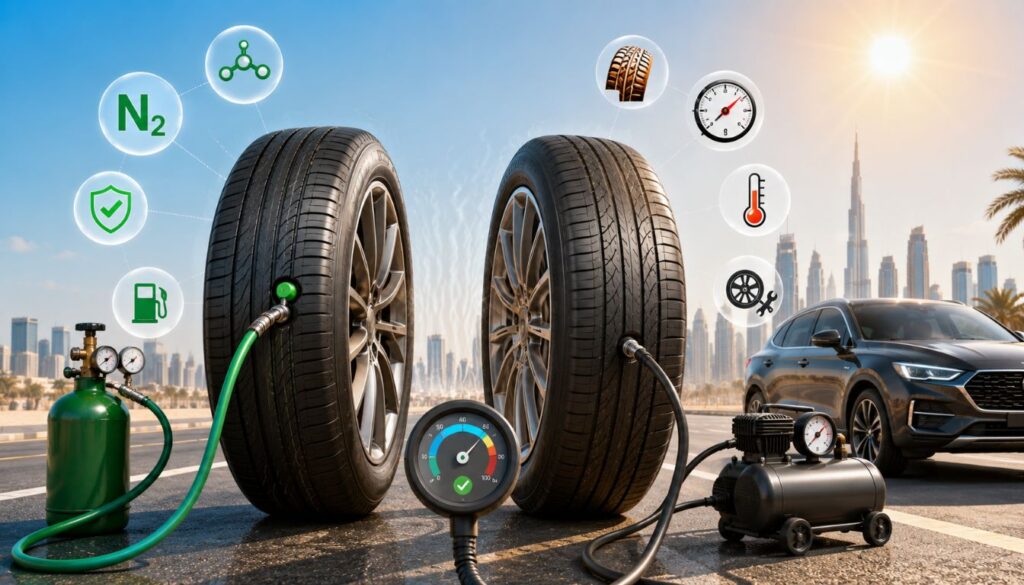

Walk into any tyre shop in Dubai, and you'll often see tyres with green valve caps, indicating they're filled with nitrogen instead of regular air. But when comparing nitrogen vs air in tyres, does nitrogen really perform better in Dubai's extreme heat?
In this guide, we'll explain the key differences, compare their performance in UAE conditions, and help you decide which option is best for your vehicle.
Many drivers are surprised to learn that regular compressed air already contains mostly nitrogen.
The air we breathe consists of approximately:
A nitrogen tyre fill simply removes most of the oxygen and moisture, leaving gas that is typically between 95% and 99% pure nitrogen.
The biggest differences are:
The tyre itself doesn't change, only the gas inside it.
Dubai is one of the harshest environments for tyres.
Your tyres may experience:
Whenever tyres heat up, the air inside expands.
This causes tyre pressure to increase naturally while driving.
Both nitrogen and regular air follow the same basic gas laws, meaning both increase in pressure as temperatures rise.
The difference lies in consistency.
Nitrogen offers two practical advantages.
Compressed air can contain water vapour depending on the compressor being used.
When moisture heats up, it expands unpredictably.
Dry nitrogen contains almost no moisture, making pressure changes slightly more consistent.
Although the difference is relatively small for everyday driving, it can become useful during prolonged high-temperature operation.
Tyres naturally lose pressure over time because gas slowly escapes through microscopic pores in the rubber.
Nitrogen molecules move through the tyre slightly more slowly than oxygen molecules.
As a result:
This doesn't eliminate pressure loss, it simply slows it down.
Independent automotive studies consistently reach similar conclusions.
Nitrogen-filled tyres generally:
However, the improvements are usually small rather than dramatic.
For drivers who already check tyre pressure regularly, the real-world difference is minimal.
Good maintenance remains far more important than the type of gas inside the tyre.
| Feature | Nitrogen | Regular Air |
| Pressure retention | Better | Good |
| Moisture inside tyre | Very low | Depends on compressor |
| Availability | Selected tyre shops | Almost everywhere |
| Cost | Usually paid service | Often free |
| Emergency top-ups | Less common | Widely available |
| Everyday performance | Slight advantage | Excellent with proper maintenance |
For most private vehicle owners, both options are perfectly safe.
Nitrogen becomes more useful if you:
If you already inspect tyre pressure every few weeks, regular compressed air performs extremely well.
Some tyre shops advertise better fuel economy with nitrogen.
Technically, this can happen but only indirectly.
When tyres remain at the correct pressure:
The improvement comes from maintaining correct pressure, not from nitrogen itself.
A properly inflated air-filled tyre provides virtually the same benefit.
Nitrogen may contribute to slightly longer tyre life because tyres remain closer to their recommended inflation pressure.
Correct tyre pressure helps reduce:
However, tyre lifespan still depends much more on:
Ignoring these factors will shorten tyre life regardless of whether the tyres contain nitrogen or air.
Yes.
This is completely safe.
If you're travelling and can't find nitrogen, adding regular compressed air is perfectly acceptable.
The only effect is that the nitrogen concentration becomes lower, reducing some of its pressure-retention advantage.
There is:
You can always switch back to nitrogen during your next service if you wish.
That depends on the price and your driving habits.
Nitrogen is often worthwhile if:
It may not be worth paying extra if:
Think of nitrogen as a maintenance upgrade rather than a performance upgrade.
Nitrogen is especially suitable for:
For occasional city drivers, regular air remains a practical and reliable choice.
Whether you use nitrogen or compressed air, follow these simple practices:
Consistent maintenance has a much greater impact than the choice between nitrogen and air.
Dubai's tyre safety campaign also encourages drivers to inspect their tyres regularly and replace worn or expired tyres to improve road safety across the emirate.
Whether you choose nitrogen or regular compressed air, maintaining the correct tyre pressure is the most important step for safe driving in Dubai's demanding climate. Regular inspections help improve handling, reduce uneven wear, and extend tyre life, regardless of what's inside the tyre.
At mathyo tyres, we help drivers across Dubai keep their tyres in excellent condition with professional tyre inspections, tyre pressure checks, nitrogen filling, wheel balancing, and mobile tyre fitting services. If you're replacing tyres or preparing for the summer season, our team can recommend the most suitable inflation option based on your driving habits and ensure every tyre is set to the correct pressure before you get back on the road.