
Run flat tyres feature reinforced sidewalls that support a vehicle after a puncture, allowing drivers to continue for up to 80 km at reduced speeds. Common on BMW, Mercedes-Benz, and Mini vehicles, they offer added safety for Dubai highways. The trade-offs are a firmer ride, higher cost, and limited repairability after being driven flat.
If your BMW, Mercedes, or Mini came with no spare tyre in the boot, you're already driving on run flat tyres. run flat tyres use a reinforced sidewall (or, less commonly, a support ring) that keeps the tyre's shape even after a complete loss of air pressure, letting you drive a limited distance at reduced speed to a tyre shop instead of stopping on Sheikh Zayed Road or Emirates Road with traffic streaming past.
In Dubai, where many premium and German imports come fitted with them as standard, understanding how they work, what they cost to replace, which brands suit which car, and whether yours can even be repaired matters more than most owners realise until they're staring at a dashboard warning light.
This guide covers what run flat tyres are, how to identify the type fitted to your car, whether they make sense on Dubai's roads, what replacement costs here, the best brands by vehicle type, and the practical decisions BMW and Mercedes owners face when a tyre is damaged.
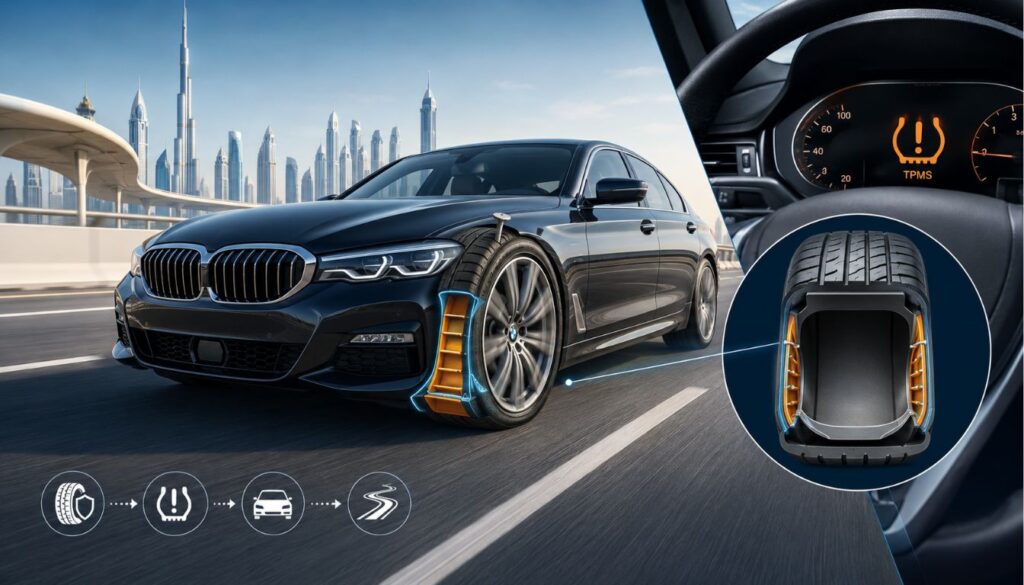
A run-flat tyre is built to support your car's weight even with zero air pressure inside it. There are two main designs in use today. Self-supporting tyres, the type fitted on nearly every BMW, have heavily reinforced sidewalls strong enough to carry the vehicle without collapsing. Self-sealing tyres, more associated with Continental, use an internal lining that closes small punctures automatically, slowing the air loss rather than eliminating it.
Drivers comparing run-flat technology with other options can benefit from understanding the different types of tyres available in Dubai and where each is best suited.
Run-flats are not optional extras you bolt onto any car. They require a Tyre Pressure Monitoring System (TPMS) to alert you the moment pressure drops, since the tyre's appearance barely changes even when flat without TPMS, you could be driving on a failed tyre without knowing it. This is why run-flats are almost always paired with TPMS as factory equipment rather than retrofitted casually.
The trade-off for that emergency mobility is a stiffer ride, since the rigid sidewall that supports the car's weight also transmits more road feel into the cabin, and a typical price premium of around 20-25% over an equivalent standard tyre.
Every manufacturer brands its run-flat technology differently, and the code is stamped directly on the sidewall. If you're not sure whether your current tyres are run-flats, or which system they use, check for one of these markings:
| Sidewall Code | Manufacturer | System Name |
| RFT / RSC | Bridgestone | Run Flat Tyre / Run-flat System Component |
| SSR | Continental | Self Supporting Run-flat |
| ZP / ZPS | Michelin / Yokohama | Zero Pressure |
| ROF / EMT | Goodyear | Run On Flat / Extended Mobility Tyre |
| DSST / ROF | Dunlop | Dunlop Self-Supporting Technology |
| HRS | Hankook | Hankook Run-flat System |
| * (star) | BMW (OE marking) | Indicates BMW-approved tyre, often run-flat |
| MO | Mercedes-Benz (OE marking) | Mercedes-Benz Original equipment approval |
If your sidewall shows none of these and there's a full-size spare in your boot, you're likely on standard tyres. When in doubt, check your owner's manual or ask a tyre technician to confirm before assuming either way.
For most daily driving in Dubai, run-flats do what they're designed for: they remove the need to pull over on Sheikh Zayed Road or Emirates Road during a puncture, which matters in a city with fast multi-lane highways and limited hard-shoulder safety margins. The ability to continue at reduced speed (typically up to 80 km/h) for a limited distance to the nearest tyre centre is a genuine safety advantage over standing roadside changing a wheel in traffic, especially at night or during summer heat.
The downside in UAE conditions is heat sensitivity. The reinforced sidewall runs hotter under load than a standard tyre, and Dubai's road surface temperatures regularly exceed 60°C in summer. This doesn't make run-flats unsafe, but it does mean tyre pressure checks matter more, not less, and the tyres tend to show wear a little earlier than the same model in a temperate climate.
Following a regular tyre rotation schedule is especially important for premium vehicles, helping distribute wear evenly across all four tyres.
If your car came with run-flats from the factory which is the case for the large majority of BMW models, most Mercedes-Benz saloons and SUVs, and all Minis sticking with run-flats is generally the simpler choice, since there's no spare wheel well to fall back on if you switch. If you're not under lease restrictions and want a more comfortable ride, switching to standard tyres is possible but requires planning, covered below.
Pricing varies by brand, size, and whether the tyre is OE (original equipment) spec for your specific model. As a general guide for the UAE market:
| Tyre Category | Typical Price Per Tyre (AED) | Examples |
| Budget run-flat | 450 – 650 | Entry-level Asian brands, smaller sizes |
| Mid-range run-flat | 650 – 950 | Hankook, Yokohama run-flat variants |
| Premium OE run-flat | 950 – 1,600+ | Bridgestone Turanza/Potenza RFT, Continental SSR, Pirelli run-flat |
Expect to pay roughly 20-25% more than the equivalent non-run-flat version of the same tyre line, which lines up with the standard industry premium for the reinforced construction. Fitting a full set of four is the more common approach for run-flats specifically, since uneven wear between a new run-flat and three older ones is more noticeable given the stiffer sidewall though single-tyre replacement is possible if the others have plenty of tread left.
Understanding these tyre replacement decisions can help drivers avoid unnecessary costs while maintaining safety and performance.
This is the most misunderstood part of run-flat ownership, and the honest answer is: it depends on the brand, and policies are stricter than most drivers expect.
Because the sidewall is reinforced to carry the car's weight, a puncture there compromises that structural integrity in a way that's hard to verify even after a patch. Driving on a run-flat at zero pressure, even briefly, can cause hidden internal damage that isn't visible from the outside, which is why most manufacturers lean toward replacement rather than repair once a tyre has been driven flat.
Policy varies by brand:
| Brand | General Repair Policy |
| Pirelli | Strict no-repair policy on run-flats once driven at zero pressure |
| Continental | Strict no-repair policy; replacement recommended |
| Bridgestone | Generally recommends replacement; case-by-case professional inspection only |
| Michelin | May allow limited tread-area repair if caught early and undamaged at zero pressure |
| Goodyear | May allow limited repair after professional inspection, similar to Michelin |
In practice, this means the convenience of driving to safety after a puncture often comes with the cost of a full replacement tyre afterward, rather than the cheaper patch-and-go repair available on a standard tyre. A repair should only ever be carried out after a proper professional inspection confirming no internal damage, and never assumed as the default outcome.
This depends on the manufacturer, but the typical guidance across BMW, Bridgestone, and Continental run-flat systems is a maximum of around 80 km/h and up to roughly 50-80 km of distance, intended to get you from the point of failure to the nearest tyre centre not to complete a long journey. Ignoring this limit risks damaging the wheel rim itself once the tyre's support capability is exhausted, which is a considerably more expensive repair than the tyre alone.
In Dubai's layout, this range is usually more than enough to reach a tyre centre from anywhere within the city, though it's worth knowing your nearest options if you frequently drive out toward Hatta, Al Ain, or other longer stretches.
Nearly every BMW sold since the mid-2000s comes with run-flats as standard, developed in close partnership with Bridgestone, and most current Mercedes-Benz saloons and SUVs follow the same approach. If you're shopping for replacements, the key thing to check is the specific OE marking on your current tyres (look for codes like BMW's "*" star marking, Mercedes' "MO" marking, or similar manufacturer-specific codes), since these indicate the tyre was developed and validated for that exact model fitting a generic run-flat without the right marking can affect ride quality and warranty standing.
For BMW owners specifically, common OE-spec run-flat choices include the Bridgestone Turanza and Potenza RFT ranges, alongside run-flat options from Continental, Pirelli, and Hankook depending on the model. We'd recommend matching the original brand and line where possible, particularly on performance or luxury models where the suspension tuning was calibrated around that specific tyre's sidewall stiffness.
If you're evaluating multiple manufacturers, our guide to the leading tyre brands for UAE roads provides a broader comparison of performance, comfort, and durability.
If you're replacing run flat tyres and want to know which brand suits your driving style rather than just matching the OE spec exactly, here's how the major options compare for UAE conditions:
| Brand & Model | Best For | UAE Strengths |
| Michelin Primacy 3 ZP | Comfort-focused saloons (5 Series, E-Class, A6) | Low road noise, long tread life, strong wet/dry braking |
| Continental ContiSportContact 5 SSR | Sporty saloons (3 Series, C-Class) | Cornering stability, reduced rolling resistance, good braking in heat |
| Bridgestone Potenza S001 RFT | Performance and M models | Heat-resistant compound, high-speed stability, precise steering |
| Goodyear Eagle F1 Asymmetric 3 ROF | Balanced daily driving | Short braking distances, comfortable highway ride |
| Pirelli P Zero PZ4 | Luxury and high-performance (AMG, M Sport, RS) | Optimised for hot-weather driving, strong dry grip |
All five are widely available with run-flat (RFT/SSR/ZP/ROF) variants suited to summer-heavy UAE driving. The right pick generally comes down to whether you prioritise ride comfort (Michelin), cornering response (Continental, Bridgestone), or a balance of both (Goodyear) luxury and performance owners tend to default to whichever brand matches their car's factory fitment, for the reasons covered above.
It's possible, and some owners do it for ride comfort, but there are two things to plan for first. Without a spare wheel well in most run-flat-equipped cars, you'll need to either carry a separate spare tyre and jack, or accept the risk of being without a backup if you get a second puncture before reaching help. Second, you'll want to confirm your insurance policy and any lease agreement don't specify run flat tyres as a condition, since some do.
If you decide to switch, the safety reasoning behind run-flats (no roadside stop on a busy highway) doesn't disappear, it's simply replaced by carrying a spare and accepting a standard tyre-change process if you're caught out.
Run flat tyres are one of those things most Dubai drivers don't think about until a warning light forces the issue, and at that point, having someone explain the brand options and repair realities clearly tends to matter more than marketing around any one name. At mathyo tyres, our mobile tyre fitting service in Dubai regularly handles run flat tyres replacements across all major brands, including Michelin, Bridgestone, Continental, Goodyear, and Pirelli.workshop visit.