
Many drivers who move to Dubai notice something surprising: tyres seem to wear out faster than they did in Europe, Asia, or North America. This is not a coincidence or bad luck. It is the result of a unique combination of climate, road conditions, driving patterns, and physics.
Understanding why tyres wear faster in Dubai is essential for choosing the right tyres, preventing premature replacement, and staying safe on UAE roads.
Heat is the single most important factor affecting tyre lifespan in the UAE. Automotive experts confirm that:
“Heat is the biggest enemy of rubber.”
In summer, ambient temperatures can reach 45°C, and tyre surface temperatures can rise much higher:
At extreme levels, tyres can become unstable or fail if heat builds excessively.
High heat accelerates rubber degradation because it:
This combination causes faster tread wear compared to cooler countries.
Temperature does not just change tyre pressure. It directly affects the physical chemistry of the rubber compound itself. Understanding this explains why tyres degrade faster in hot climates like Dubai.
Air inside a tyre follows the gas law principle where pressure rises as temperature increases. In practical terms, tyre pressure increases roughly 1 to 2 PSI for every 10°C temperature rise. When tyres heat up during driving, internal pressure increases, which changes how the tyre contacts the road surface.
This can cause two wear patterns:
Both lead to accelerated wear compared to tyres operating at stable temperatures.
Tyres are made from complex polymer compounds, primarily natural and synthetic rubber reinforced with carbon black, silica, sulfur crosslinks, and stabilizing additives.
At high temperatures, several chemical processes speed up:
Heat accelerates reactions between oxygen and rubber polymers. This breaks molecular chains and weakens elasticity.
As temperature rises, polymer bonds vibrate more intensely. When heat exceeds certain thresholds, these bonds begin to break down, reducing structural strength.
Tyres rely on sulfur crosslinks formed during vulcanization. Excessive heat can weaken these crosslinks, making rubber softer and more prone to abrasion.
Rubber compounds contain oils and plasticizers that maintain flexibility. Heat causes these compounds to evaporate faster, leading to hardening and cracking.
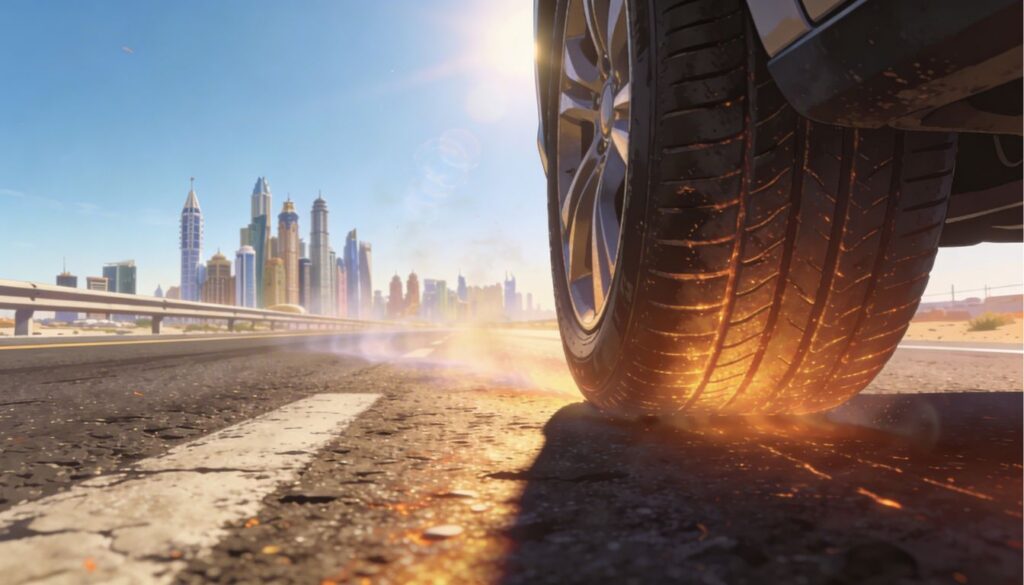
It is not just the air temperature. Road surfaces in Dubai absorb heat and become extremely hot.
At high temperatures:
This effect is confirmed by UAE automotive specialists, who explain that heat softens tyre materials and increases wear and burst risk.
Heat does not just wear tyres mechanically. It also damages them chemically.
Experts explain that high temperatures can:
This “dehydration” effect makes tyres more prone to cracks and splits.
Rubber aging is one reason tyres in the UAE often need replacement earlier than expected.
Scientific research shows that frictional heating is a major contributor to rubber wear. Studies on rubber friction demonstrate that heat generated during contact with road surfaces increases the real contact area and affects wear rate.
In simple terms:
more heat → more friction → faster wear
Because Dubai roads are already hot, tyres start closer to this high-wear condition before driving even begins.
Environmental conditions are not the only factor. Driving style also plays a role.
Tyres wear faster due to:
These behaviors were identified as major reasons tyres wear out faster in the UAE.
Highway driving above 100 km/h increases tread temperature significantly, multiplying wear.
Many UAE residents drive long distances daily or carry heavy loads for travel and work. Excessive weight increases rolling resistance and tyre temperature, which accelerates wear.
Even seasonal travel, such as road trips, adds load stress that shortens tyre life.
Dubai roads are generally high quality, but several environmental factors still affect tyres:
Misalignment caused by these factors can drastically reduce tyre lifespan.
Under ideal conditions, tyres may last:
But experts say tyres often wear out faster than this in the UAE due to heat, maintenance issues, and driving conditions.
Tyres designed for cooler climates may not tolerate Dubai heat well. Tyres with higher heat resistance ratings last longer and perform better in extreme conditions.
Specialized tyres built for hot climates may cost more initially but can last significantly longer, making them more economical in the long run.
Tyres wear faster in Dubai because multiple stress factors combine at once:
Most countries have one or two of these factors. Dubai has all of them simultaneously.
That is why tyre lifespan here is often shorter than in cooler regions and why choosing tyres suited for the UAE climate is critical.
Many drivers now check tyre specifications and suitability carefully with experienced providers such as mathyo tyres before installation, especially during summer months when tyre stress is highest.