
Buying new tyres is not simply a matter of choosing a familiar brand or finding the lowest price. The right tyres need to match your vehicle, driving habits, road conditions and the UAE climate. A tyre that works well for a daily city commute may not be the right choice for frequent desert driving, while an aggressive off-road tyre may be unnecessary for someone who spends most of their time on Dubai highways.
If you are comparing tyres for a new purchase, there are several important factors to check before placing an order. This car tyre buying guide explains the main things to consider when buying car tyres in the UAE, including tyre size, weather, tread pattern, load and speed ratings, driving conditions, tyre age, brand, budget and professional installation.
The first thing to check when buying tyres is the correct size for your vehicle. You can usually find the recommended specification in the vehicle owner's manual, on the driver's door-jamb sticker or on the existing tyre sidewall.
A typical specification may look like 225/55 R17 97W. Each part provides information about the tyre's dimensions, construction, load capacity and speed capability.
Choosing the correct size matters because tyres are designed to work within specific dimensions and load requirements. Changing to an unsuitable size can affect handling, ride comfort, clearance, speedometer readings and other vehicle characteristics.
If you are unfamiliar with tyre markings, our guide to understanding tyre sizes explains how these numbers and letters work.
The UAE climate is one of the most important factors when choosing tyres. High temperatures, hot road surfaces and prolonged exposure to sunlight can place additional stress on rubber compounds.
This does not mean that you need a tyre marketed specifically as a "summer tyre" for every vehicle. Instead, look for tyres that are suitable for the vehicle and operating conditions and follow the manufacturer's specifications.
Heat can also contribute to faster tyre ageing and wear when tyres are poorly maintained. Regular inspection becomes particularly important in Dubai and other UAE cities.
If you want to understand the local factors behind accelerated wear, see our guide on why tyres wear faster in Dubai.
When comparing tyres for UAE driving, consider:
The goal is not simply to find the tyre with the most aggressive specifications. It is to find one that matches how your vehicle is actually used.
Your normal driving environment should influence your tyre choice.
A driver who spends most of the week travelling between Downtown Dubai, Business Bay, Sharjah and Abu Dhabi has different requirements from someone who regularly drives on sand, gravel and rocky trails.
For predominantly urban and highway driving, you may place greater importance on:
Drivers who regularly travel away from paved roads may need different characteristics, including:
If you regularly compare road tyres with off-road options, our guide to off-road tyres vs normal tyres provides a more detailed comparison.
For SUVs and 4x4s, our guide to best off-road tyres for SUVs and 4x4s in Dubai is also relevant.
The tread is one of the most visible parts of a tyre, but choosing based purely on appearance can be misleading.
Different tread designs are engineered for different combinations of traction, handling, noise, water evacuation and durability.
For normal road use, a tyre designed for paved surfaces may provide a better balance of comfort and road performance than an aggressive off-road pattern.
For drivers who regularly travel over loose surfaces, an appropriate all-terrain or off-road design may provide additional traction.
The important point is to match the tread design to your actual driving conditions rather than selecting a tyre simply because it looks more aggressive.
You can also learn about different tyre constructions and categories in our guide to types of tyres explained for Dubai drivers.
The load index tells you how much weight a tyre is designed to carry under specified conditions.
This becomes especially important for SUVs, 4x4s, larger sedans and vehicles that regularly carry passengers or luggage.
For example, a vehicle that is frequently loaded for long-distance journeys may require tyres with an appropriate load capacity rather than simply choosing whatever tyre is cheapest in the correct dimensions.
You can learn more about this specification in our guide to extra load tyres.
Always follow the vehicle manufacturer's recommended specifications rather than increasing or reducing load capacity without understanding the implications.
The speed rating indicates the maximum speed capability of a tyre under specified test conditions.
It is represented by a letter on the tyre specification, such as H, V, W or Y.
For UAE drivers who frequently use highways, the correct speed rating is an important part of selecting tyres. However, a higher speed rating does not automatically mean a tyre is better for every driver.
The tyre should meet the vehicle manufacturer's requirements and suit your normal driving conditions.
Our detailed guide to tyre speed rating explains what the different ratings mean.
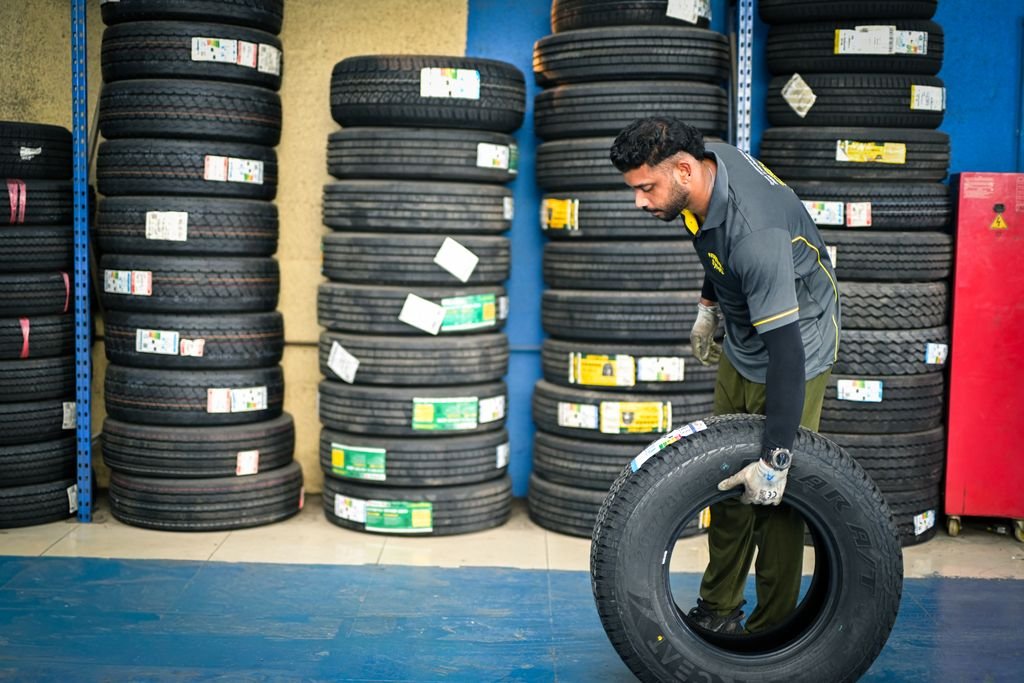
A tyre can look new while still having been manufactured some time ago. When buying new tyres, checking the manufacturing date is therefore useful.
Tyres have a date code on their sidewall that allows you to determine when they were manufactured.
This matters because rubber gradually ages due to time and environmental exposure. In the UAE, where temperatures can be high for much of the year, keeping track of tyre age is particularly sensible.
Before purchasing, learn how to check the tyre year so you know what you are actually buying.
Brand matters, but it should not be the only factor.
Different tyre manufacturers offer different product lines covering everyday commuting, touring, performance, SUVs, off-road vehicles and commercial applications.
When comparing brands, consider:
Some commonly encountered brands in the UAE market include Bridgestone, Goodyear, Dunlop, Continental, Hankook, Cooper, BFGoodrich and CEAT.
BFGoodrich is particularly associated with SUV and off-road applications. However, the correct model still depends on the vehicle and how it is driven.
If your searches include Goodrich tyres Dubai, focus on matching the specific BFGoodrich model to your vehicle and driving conditions rather than choosing the brand alone.
Bridgestone has product lines covering various passenger-car and SUV applications. When considering a Bridgestone tyre service, check that the exact tyre specification matches your vehicle before installation.
If you are comparing CEAT tyres online, check the complete specification rather than judging the tyre by brand and price alone. Size, load index, speed rating and manufacturing date should all be part of the comparison.
For drivers searching for Continental tyre Dubai options, the same principle applies: compare the exact model and specification according to your vehicle and driving requirements.
Cooper tyres are another option that may appear in comparisons for SUVs and off-road vehicles. The appropriate model depends on whether the vehicle is primarily driven on roads, mixed terrain or more demanding off-road surfaces.
Drivers looking for Dunlop Dubai options should compare the available models according to vehicle specification and intended use rather than assuming every Dunlop tyre is designed for the same purpose.
Goodyear tyres are available across different vehicle categories and applications. Compare the individual product specification, especially if you are selecting tyres for an SUV or long-distance highway use.
If you are comparing Hankook tyres Dubai, consider the specific tyre range, vehicle requirements, driving environment and expected mileage before making a purchase.
For a broader comparison of tyre manufacturers and options, see our guide to tyre brands in Dubai.
Price is naturally an important part of buying new tyres, but the cheapest option is not necessarily the lowest-cost option over the tyre's entire service life.
A cheaper tyre may have a lower initial purchase price, while another tyre may offer different characteristics in areas such as mileage, braking performance, comfort or durability.
The right approach is to compare value rather than price alone.
If you are working with a tighter budget, our guide to the best budget tyre brands in the UAE covers affordable options and the factors to consider when comparing them.
You can also compare cheap tyres online vs premium tyres before deciding how much to allocate to your next set.
If only one tyre is damaged, replacing the entire set may not always be necessary. However, replacing tyres individually can create differences in tread depth and performance between tyres.
The correct approach depends on the vehicle, tyre condition, axle configuration and manufacturer's recommendations.
If several tyres have significant wear, replacing them together may provide more consistent performance.
Our tyre replacement guide explains the main situations in which replacement should be considered.
You can also check our guide on signs that your tyres are worn out if you are unsure whether your current tyres have reached the end of their usable life.
Tyre pressure affects handling, braking, comfort, rolling resistance and tyre wear.
Before buying tyres, know the recommended pressure for your vehicle. Remember that the correct pressure is generally based on the vehicle manufacturer's specification, not necessarily the maximum pressure printed on the tyre sidewall.
UAE temperatures can also cause pressure readings to change, which is why regular checks are important.
Our tyre air pressure chart and performance guide explains how pressure affects driving and tyre performance.
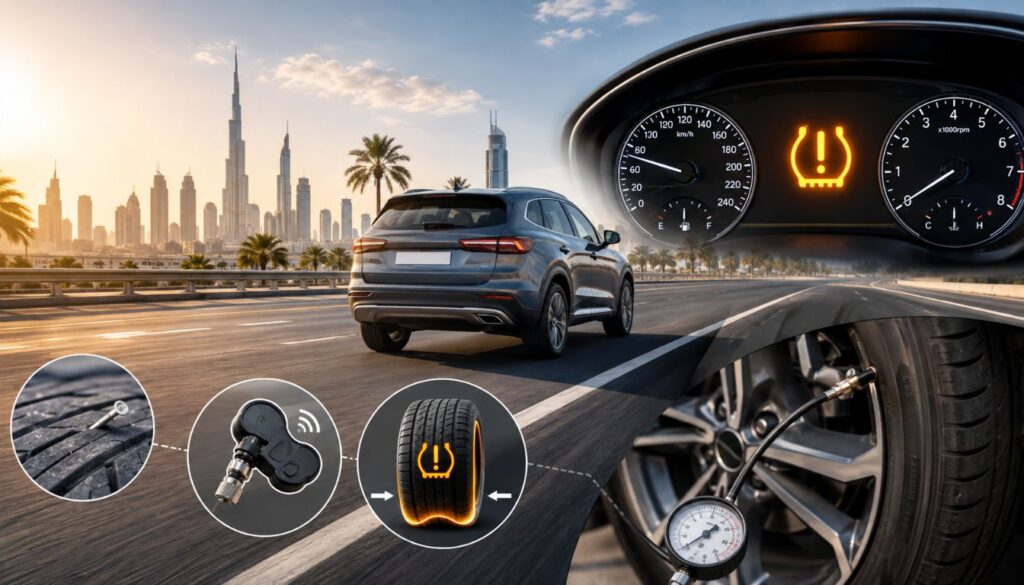
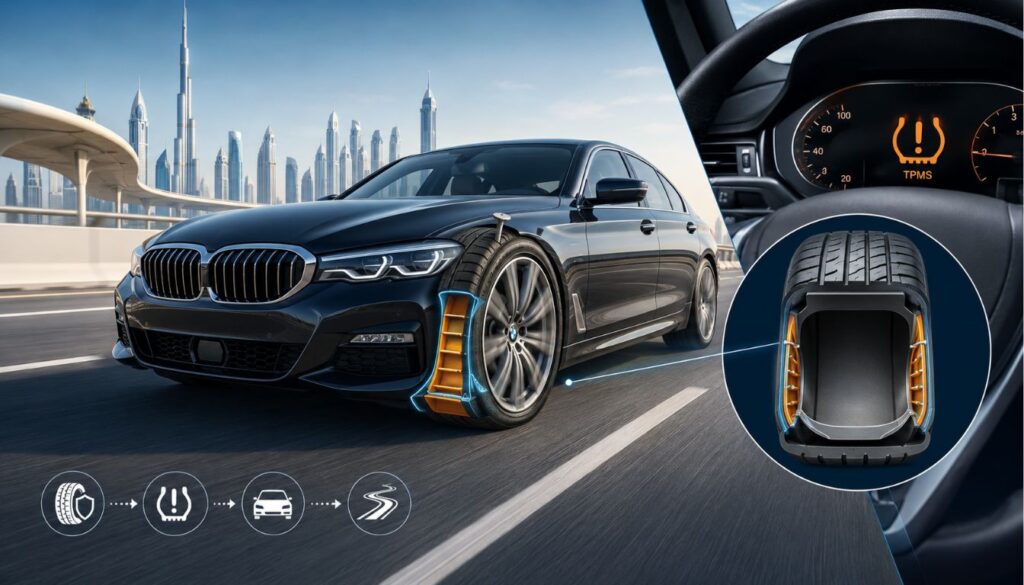
Modern vehicles can have systems that interact with the tyres, including TPMS.
If your car uses a tyre pressure monitoring system, make sure the replacement process accounts for the system and that sensors are correctly handled when required.
A warning light should not simply be ignored after new tyres are installed.
For more information, see our guide to the TPMS warning light in Dubai.
A tyre is one of the few parts of your car that remains in direct contact with the road throughout the journey. Its construction and tread design can therefore influence the amount of road noise transmitted into the cabin.
If you spend several hours each week driving on Dubai highways, comfort and noise may be more important to you than they are to someone who primarily drives short urban journeys.
However, tyre noise can also indicate problems such as uneven wear, incorrect pressure or wheel-related issues. If you notice unusual noise after fitting new tyres, investigate the cause rather than assuming it is normal.
Buying the right tyres is only part of the job. Correct installation is equally important.
After replacing tyres, wheel balancing service can help ensure that the wheel and tyre assembly rotates smoothly. An imbalance may contribute to vibration, particularly at certain speeds.
Wheel balancing should not be confused with wheel alignment. They address different aspects of vehicle operation.
For a deeper explanation of the costs and process, see our wheel balancing cost in Dubai guide.
When comparing prices online or between tyre shops, look beyond the headline tyre price.
Ask whether the quoted amount includes:
This makes it easier to compare like-for-like offers.
Our guide to tyre fitting cost in the UAE explains the different services that can contribute to the overall cost.
Buying tyres online can make price and specification comparisons easier, but the buyer still needs to verify the details.
Before ordering, check:
Our guides on buying tyres in Dubai and buying tyres online in Dubai cover the online purchasing process in more detail.
If you are specifically comparing online purchasing options, you can also read about choosing car tyres online.
Before spending money on a new set, inspect your current tyres.
Look for:
If you are experiencing one of these problems, identifying the underlying cause is important. Simply installing another set of tyres without addressing alignment, balancing, pressure or suspension problems could result in the new tyres wearing prematurely.
If you are asking "do I need new tyres?", our need new tires guide provides a practical checklist.
Your ownership plans can also influence your decision.
If you plan to keep the vehicle for several years, durability, mileage and long-term value may deserve greater attention. If you expect to sell the vehicle relatively soon, you may approach the purchase differently while still meeting all safety and manufacturer requirements.
Either way, avoid choosing tyres solely on the basis of the lowest initial price.
A very low price deserves closer inspection.
Before accepting an offer, verify the tyre's brand, model, size, manufacturing date, condition and included services.
You should also understand exactly what you are paying for. A tyre advertised at a low price may have additional fitting, balancing or delivery charges.
Our guide to common tyre shop scams in Dubai covers several issues UAE drivers should watch for when comparing tyre offers.
The purchase does not end when the tyres are fitted.
A good tyre-buying decision should also consider what happens if you experience a puncture, pressure issue, vibration or another tyre-related problem later.
This is particularly useful for drivers who depend heavily on their vehicle for commuting or business.
A provider that can offer tyre replacement, fitting, inspection and related support can make tyre ownership easier after the initial purchase.
There is no single tyre that is automatically the right choice for every UAE driver.
| Factor | Mostly City/Highway Driving | Desert/Off-Road Driving |
|---|---|---|
| Main priority | Comfort and road performance | Traction and durability |
| Tread | Road-focused | All-terrain/off-road depending on use |
| Noise | Lower road noise may be important | Usually less important |
| Sidewall | Standard road requirements | Stronger construction may be useful |
| Driving surface | Asphalt and highways | Sand, gravel and rocky terrain |
| Key consideration | Wet/dry grip and comfort | Traction and resistance to damage |
| Vehicle examples | Sedans, crossovers | SUVs and 4x4s |
The important distinction is actual usage. An SUV does not automatically require an aggressive off-road tyre, just as a sedan driven in Dubai does not need an off-road pattern.
Before you place your order, check these points:
Vehicle
Driving
Climate
Tyre
Purchase
After installation
Choosing tyres is easier when the purchase is based on your vehicle and actual driving conditions rather than a brand name or price alone. For Dubai drivers, factors such as heat, highway use, tyre condition, correct specifications and professional installation all matter.
mathyo tyres provides tyre replacement, professional fitting, wheel balancing and tyre support across Dubai. The company states that it supplies genuine ESMA-approved tyres compliant with UAE safety standards and provides tyre advice based on the vehicle and customer's requirements.
If you need tyres replaced at home, an office, basement parking area or roadside, Mathyo Tyres also provides mobile tyre fitting and emergency replacement services across Dubai.
The practical approach is simple: confirm your vehicle's specifications, choose tyres suited to your driving environment, verify the tyre's condition and age, and have them professionally installed and balanced.
The things to consider when buying car tyres go well beyond price and brand. The correct tyre should match your vehicle's size and specifications while also fitting your driving environment, climate, mileage, load requirements and budget.
For UAE drivers, the decision becomes particularly important because of high temperatures, extensive highway driving and the mix of urban and desert conditions. Check the tyre size, load and speed ratings, tread pattern, manufacturing date and expected use before buying.
Whether you are comparing Bridgestone, Continental, Goodyear, Dunlop, Hankook, BFGoodrich, Cooper, CEAT or another manufacturer, focus on the specific tyre model and specification, not just the brand name. Once you have selected the right tyres, professional fitting and wheel balancing can help ensure they perform as intended.